
Manila Commercial Property Management: 5 Common Problems and Practical Solutions for Property Owners
更新日:10月9日

Owning commercial property in Metro Manila can provide strong long-term opportunities, but keeping a property profitable is not always straightforward. Changing business requirements, competition between buildings, operating costs, tenant expectations, and market uncertainty can all affect occupancy and investment returns.
In 2026, Metro Manila continues to have significant commercial leasing activity, particularly in major business districts such as Makati, Bonifacio Global City, and Ortigas. However, property owners are operating in a competitive environment. Colliers reported an overall Metro Manila office vacancy rate of around 19% in the second quarter of 2026, while businesses are increasingly looking for flexible, well-located, efficient, and modern spaces.
For commercial property owners, simply putting a space on the market may no longer be enough.
Understanding the most common Manila commercial property issues can help owners make better decisions about pricing, maintenance, renovations, marketing, and tenant management.
Here are five common problems commercial property owners face—and practical ways to address them.
1. High Vacancy and Long Marketing Periods

One of the biggest concerns for any commercial property owner is having an office, retail unit, or commercial space remain vacant for several months.
A vacant property does not simply mean losing rental income. Owners may still have to pay association dues, real property taxes, insurance, maintenance expenses, utilities, and other ownership costs.
Competition is also significant.
Metro Manila's office market recorded approximately a 19% overall vacancy rate in Q2 2026, according to Colliers. With many spaces available, prospective tenants often have several properties to compare before making a decision.
Why Commercial Properties Stay Vacant
Several factors can contribute to prolonged vacancy:
Rental rates that are above comparable properties
Poor property condition or outdated interiors
Weak online exposure
Limited broker or agent networks
Inconvenient location or transportation access
Strict lease conditions
Slow responses to inquiries
Lack of facilities businesses currently require
Practical Resolution
Owners should regularly conduct a commercial property market comparison.
Instead of determining rent only according to the owner's desired return, compare the property against similar spaces based on:
Location
Building grade
Floor area
Condition
Furnishing
Parking availability
Accessibility
Building amenities
Lease terms
A small adjustment in asking rent can sometimes significantly increase inquiries.
Owners can also consider incentives such as reasonable fit-out periods, flexible lease structures, or negotiations for longer-term tenants.
The objective should not always be achieving the highest possible monthly rent. In some situations, accepting a slightly lower rental rate with a reliable tenant can produce a better annual return than keeping the property vacant while waiting for a higher offer.
2. Rental Price Does Not Match the Current Market
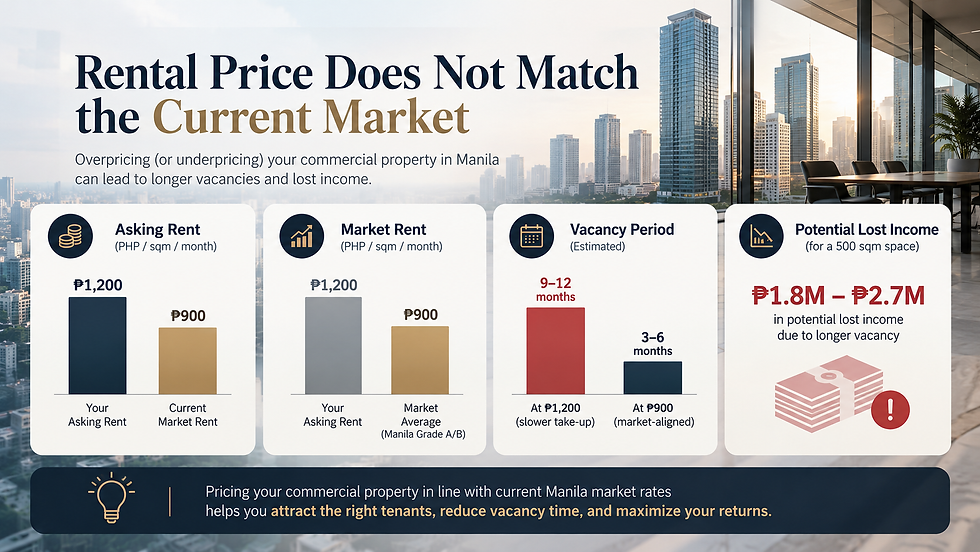
Commercial owners naturally want to maximize their rental income. However, pricing a property based entirely on historical rates or the owner's acquisition cost can make the property less competitive.
Commercial real estate markets change continuously.
New buildings enter the market, older developments offer discounts, companies change their space requirements, and different business districts compete for tenants.
Cushman & Wakefield reported that average Metro Manila office headline rents reached approximately ₱964 per square meter per month in Q2 2026, although rental levels vary considerably depending on location, building quality, and submarket.
The Risk of Overpricing
Suppose a property could realistically rent for ₱100,000 per month but is marketed at ₱120,000.
If the owner waits six months for someone willing to pay the higher amount, the lost potential rent could reach ₱600,000.
Even if a tenant eventually accepts ₱120,000, recovering the income lost during the vacancy could take years.
Practical Resolution
Owners should review their asking price regularly, particularly when:
There have been few inquiries for several months
Prospective tenants repeatedly say the price is too high
Similar units are leasing faster
New commercial developments enter the area
Existing tenants request large discounts at renewal
A professional market assessment should consider both asking prices and actual market behavior.
The right rental price should balance two objectives:
Protect the property's value while remaining competitive enough to attract qualified tenants.
3. Outdated Commercial Spaces Struggle Against Newer Buildings

Commercial tenants today evaluate much more than floor area.
Businesses consider employee comfort, internet reliability, electrical capacity, energy efficiency, building security, accessibility, elevators, air-conditioning systems, sustainability, parking, and the overall image of the building.
An older property may still be located in an excellent business district, but outdated interiors or facilities can make it difficult to compete with newer developments.
Colliers reported that green-certified buildings accounted for 68% of Metro Manila office transactions during the first half of 2026, highlighting the growing importance businesses place on efficient and sustainable workplaces.
Signs a Commercial Property May Need Improvement
Common warning signs include:
Old lighting
Worn flooring
Damaged ceilings
Outdated office partitions
Poor air-conditioning
Insufficient electrical outlets
Weak internet infrastructure
Old toilets or pantry facilities
Dark interiors
Visible maintenance problems
Practical Resolution
Owners do not always need a complete renovation.
Focus first on improvements that prospective tenants notice immediately.
These can include:
Fresh paint
Improved lighting
Professional cleaning
Air-conditioning servicing
Repairing damaged flooring
Removing unnecessary partitions
Improving electrical capacity
Updating the pantry and toilets
Improving internet connectivity
Creating a more flexible floor layout
Before spending heavily on renovations, owners should identify the type of tenant they want to attract.
A law firm, restaurant, clinic, BPO company, retail business, and technology company may all require very different property configurations.
Renovation should therefore be connected to a clear leasing strategy.
4. Rising Operating and Maintenance Costs Reduce Returns

Rental income may increase over time, but property expenses can increase as well.
Commercial property owners may have to manage:
Association dues
Real property tax
Insurance
Repairs
Air-conditioning maintenance
Property management costs
Building assessments
Utilities
Renovation costs
Broker commissions
Vacancy-related expenses
A property generating attractive gross rental income may produce a significantly lower net return once these expenses are considered.
Practical Resolution
Owners should maintain a clear annual property budget.
Instead of looking only at monthly rent, calculate:
Annual Rental Income – Annual Property Expenses = Net Property Income
Track expenses such as maintenance and repairs so recurring problems can be identified.
Preventive maintenance is particularly important.
For example, delaying air-conditioning servicing, waterproofing, plumbing repairs, or electrical maintenance can eventually create larger and more expensive problems.
Owners should also review whether upgrades that reduce electricity consumption or maintenance requirements can improve long-term operating efficiency.
The goal is not simply to reduce expenses.
The goal is to spend money where it protects the property, supports tenant retention, and prevents larger future costs.
5. Tenant Turnover Creates Additional Cost and Vacancy Risk
Finding a commercial tenant takes time.
Once a reliable tenant is secured, keeping that tenant can often be financially more efficient than continuously replacing occupants.
When a tenant leaves, the owner may experience:
Several months without rental income
Brokerage expenses
Cleaning costs
Repairs
Renovation requests
Marketing expenses
Administrative work
New lease negotiations
For this reason, tenant retention can have a significant impact on the property's long-term profitability.
Why Commercial Tenants Leave
Businesses may relocate because of:
Increasing rental rates
Maintenance problems
Poor communication
Lack of parking
Accessibility concerns
Business expansion
Downsizing
Better offers from competing buildings
Changes in workplace strategy
Flexible workspace demand has also increased as companies look for more scalable arrangements rather than committing immediately to large conventional offices.
Practical Resolution
Property owners should communicate with tenants before the lease expiration date rather than waiting until the final month.
Start discussions early regarding:
Renewal intentions
Rental adjustments
Maintenance concerns
Additional space requirements
Possible improvements
Lease-term flexibility
A reliable tenant paying a reasonable rental rate may sometimes provide greater financial value than repeatedly searching for tenants willing to pay the highest possible price.
The Manila Commercial Property Market Is Becoming More Competitive
Metro Manila remains one of the Philippines' most important commercial real estate markets.
Makati, BGC, Ortigas, Quezon City, Pasay, Alabang, and emerging business districts continue to attract local companies, multinational corporations, outsourcing businesses, retailers, and professional firms.
Demand has not disappeared.
JLL reported positive office absorption during Q2 2026, with corporate leasing activity particularly supporting Makati and Taguig.
However, tenants have more choices and are becoming more selective.
Location alone may no longer be enough.
Successful commercial properties increasingly combine:
Competitive pricing
Good accessibility
Professional maintenance
Flexible layouts
Reliable building infrastructure
Strong property management
Responsive owner representation
Effective marketing
For owners, this means commercial property management should become more proactive rather than reactive.
What Should Manila Commercial Property Owners Do?
Owners who are experiencing limited inquiries, prolonged vacancy, or repeated tenant turnover should begin with a simple property review.
Compare your property with competing listings and ask:
Is the price realistic?
Does the space still meet current business requirements?
Is the property being marketed to the right type of tenant?
Are maintenance problems affecting its attractiveness?
Are the lease conditions competitive?
Small changes in pricing, presentation, marketing, or property condition can sometimes produce a meaningful improvement in leasing performance.
Commercial property should be treated as an operating investment rather than simply a physical asset.
Owners who regularly monitor the market, maintain their properties, understand tenant requirements, and adjust their leasing strategy are generally better positioned to protect occupancy and long-term property value.
Need Help Managing or Leasing a Commercial Property in Manila?
Managing a commercial property becomes more challenging when the owner is overseas or does not have time to coordinate inquiries, tenants, maintenance, documentation, and market research.
BedandGo Inc. assists property owners with commercial property marketing, leasing coordination, property management, market research, and other real estate requirements in Metro Manila.
Whether your commercial property is located in Makati, BGC, Ortigas, Pasay, Quezon City or other key Metro Manila business districts, reviewing its current market position can be an important first step toward improving its performance.
A well-managed property is not simply one that receives rent every month.
It is one that remains competitive, properly maintained, attractive to tenants, and positioned for sustainable long-term returns.


コメント