Manila Real Estate Investment: 7 Reasons Why Japanese Buyers Are Focusing on Makati Condominiums in 2026
更新日:6月1日

For many Japanese buyers, choosing a condo in Metro Manila is not only about finding a property. It is about finding a location that feels practical, stable, and easy to understand. This is why Makati continues to stand out. It has long been known as one of the Philippines’ main business and financial centers, with major offices, commercial establishments, residential towers, hotels, malls, and daily conveniences concentrated in one city. Manila real estate investment is becoming more relevant for Japanese buyers who want practical condo options in established business districts like Makati.
Makati is also described as the Philippines' main financial and business hub, and its daytime population rises significantly because of workers and visitors coming into the city. For Japanese buyers coming from Tokyo, Makati may feel familiar in some ways. It has business districts, walkable lifestyle areas, high-rise residences, restaurants, banks, clinics, malls, and office towers within a compact urban setting. However, the property market is different from Japan, and buyers still need to review legal rules, building condition, rental demand, costs, and resale potential carefully.
This guide explains why Makati condos remain attractive to Japanese buyers today, while also keeping the discussion practical and balanced.

Manila Real Estate Investment: Why Makati Condos Attract Japanese Buyers
One reason Makati appeals to Japanese buyers is its business-district environment. Like parts of Tokyo, Makati has areas where office, residential, dining, shopping, and daily services are close together. The Makati Central Business District is home to many multinational companies, banks, and major businesses, and the city is recognized as one of Metro Manila’s dominant office markets.
For Japanese buyers, this matters because daily convenience is often a major part of property value. A condo near offices, malls, restaurants, clinics, grocery stores, and banks can be easier to use, lease, or resell than a unit in a less connected area. Many buyers are not only thinking about the unit itself; they are also thinking about how easy the location is for daily life.
This is especially relevant for buyers who may use the unit personally during business trips, assign it to staff, rent it to professionals, or hold it as a long-term investment. Makati’s appeal comes from its established urban function, not just its skyline.
Still, buyers should compare exact locations carefully. A condo in Legazpi Village, Salcedo Village, Poblacion, Rockwell, or near Ayala Avenue can offer different tenant profiles, price points, and lifestyle advantages.
Strong Office Activity Supports Rental Demand
Makati’s office base is one of the reasons its condo market remains relevant. Residential demand in business districts is often connected to employment, corporate activity, and daily commuting patterns. Colliers reported that Metro Manila office vacancy eased to 19.0% in Q1 2026, supported by the absence of new office completions during the period.
For Japanese buyers, this is important because rental demand is usually stronger when the surrounding area has active employment. Makati condos can appeal to corporate tenants, foreign workers, professionals, consultants, and business travelers who want to reduce commute time and live close to offices.
However, rental demand should never be assumed only because the condo is in Makati. Buyers should check the specific building. Important questions include:
How many similar units are currently for rent?
Are units being leased quickly or staying vacant?
Are current rents realistic compared with asking prices?
Is the unit furnished to match the target tenant?
Is the building well-managed and attractive to expat tenants?
Makati’s business activity can support demand, but the specific building and unit still determine the actual rental performance.
Makati Has Lifestyle Convenience That Japanese Buyers Can Understand
Japanese buyers often value convenience, cleanliness, safety, transport access, and nearby daily services. Makati can be attractive because many residential areas are close to malls, restaurants, parks, convenience stores, offices, and healthcare options.
Areas such as Legazpi Village and Salcedo Village are often considered practical because they combine residential towers with restaurants, offices, parks, and daily services. Rockwell offers a more premium residential environment, while Poblacion has a more active dining and lifestyle character. These differences give buyers several options depending on their purpose.
This lifestyle convenience is important for both personal use and leasing. A tenant may accept a smaller unit if the surrounding area is easy to live in. For example, a studio or one-bedroom unit near offices and lifestyle areas may be more practical than a larger unit that requires longer travel for work and daily needs.
That said, buyers should not rely only on the neighborhood name. They should still check walkability, traffic, noise, nearby construction, building access, and the condition of the common areas.
4. Condos Are One of the Few Practical Ownership Options for Foreign Buyers
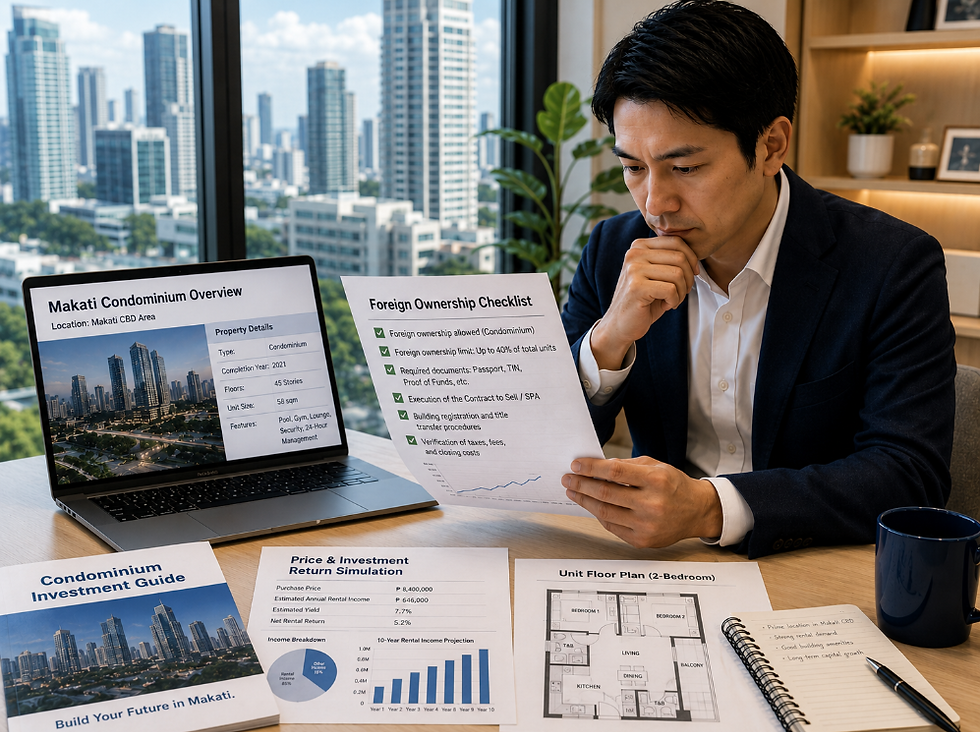
Foreign buyers cannot generally own land in the Philippines, but they may buy condominium units as long as foreign ownership in the condominium corporation does not exceed 40%. The Philippine Consulate General in Sydney explains that foreign nationals may buy condominium units in Philippine condos as long as not more than 40% of the units in a project are foreign-owned.
This makes condos a practical real estate option for Japanese buyers who want property exposure in Metro Manila. However, the 40% foreign ownership rule must be checked before making an offer. Some popular or older buildings may already have a high foreign ownership percentage.
Before buying, Japanese buyers should request confirmation of:
Available foreign ownership quota
Clean Condominium Certificate of Title
Updated tax and dues status
Seller authority to sell
Building rules on leasing, renovation, pets, and move-in
Any restrictions that may affect foreign buyers
This is a key step. A unit may look attractive, but if the foreign ownership quota is already full, the buyer may not be able to proceed legally.
5. Makati Can Work for Both Personal Use and Investment, But Numbers Still Matter
Makati condos can appeal to Japanese buyers because they offer flexibility. A unit may be used as a personal city base, rented to tenants, held for resale, or used for future relocation plans. This flexibility is one reason condos in prime business districts continue to attract attention.
But investment decisions should still be based on numbers, not just location. Metro Manila’s residential market remains selective. Colliers’ 2026 Philippine Property Market Outlook describes a market shaped by both headwinds and tailwinds, where developers and investors need to navigate shifting demand, consumer behavior, and inventory conditions.
Buyers should calculate the real cost of ownership. This includes:
Purchase price
Taxes and transfer-related expenses
Association dues
Repairs and maintenance
Furnishing cost
Property management fee
Vacancy period
Expected rent
Future resale liquidity
A Makati condo can be attractive, but it should still make sense after all costs are counted. A lower-priced unit with high dues or weak rental demand may not perform well. A fair-priced unit in a strong building with good tenant appeal may be a better long-term choice.
6. Japanese Buyers Should Compare Building Quality Carefully
Makati has a wide range of condo buildings. Some are older but well-located. Some are premium and better maintained. Others may have good layouts but weaker common areas or higher monthly dues. This makes building-level inspection very important.
Before buying, Japanese buyers should check:
Lobby and common area condition
Elevator performance
Building management quality
Security and visitor control
Water pressure and drainage
Air-conditioning setup
Internet provider options
Noise from traffic or nearby construction
Flood history and surrounding road condition
Repair history and upcoming assessments
This is especially important for resale condos. A unit may look good in photos, but the building may have hidden issues. The opposite can also be true: a dated unit in a strong building may become a good investment after renovation.
For Japanese buyers used to strict building maintenance standards, this step should not be skipped.
7. Makati’s Appeal Is Strong, But It Is Not Automatic
Makati remains attractive because of its business role, lifestyle convenience, rental base, and long-established reputation. But not every Makati condo is a good buy. The best option depends on the buyer’s purpose.
A buyer looking for rental income may prioritize tenant demand, furnishing, rent levels, and vacancy. A buyer looking for future personal use may prioritize layout, building comfort, access to restaurants, and daily convenience. A buyer focused on resale may prioritize building reputation, pricing, and liquidity.
The safest approach is to compare the exact building, exact unit, and exact numbers. Makati can provide a strong foundation, but due diligence still decides whether the purchase is suitable.

Conclusion
From Tokyo to Makati, Japanese buyers may find Makati condos attractive because the city offers a familiar urban rhythm: business activity, high-rise living, lifestyle convenience, and access to daily services. Makati’s established role as a business and financial center gives many condos a clear use case for both personal living and rental investment.
However, buyers should remain practical. The strongest Makati condo is not always the newest, most expensive, or most famous building. It is the unit that fits the buyer’s purpose, has legal availability for foreign ownership, sits in a well-managed building, supports realistic rental demand, and makes sense after all ownership costs are included.
For Japanese buyers comparing Makati condos, BedandGo can help review available units, check building-level details, compare rental potential, and guide the due diligence process before buying.
Sources IGES — Makati City Voluntary Local Review
Colliers Philippines — Q1 2026 Office Property Market Report
Colliers Philippines — 2026 Philippine Property Market Outlook
Philippine Consulate General Sydney — Owning Land in the Philippines
Makati City Government


コメント