
Manila Real-estate Investment: Makati Vs. BGC 5 Different Features that Commercial Spaces Benefit from.
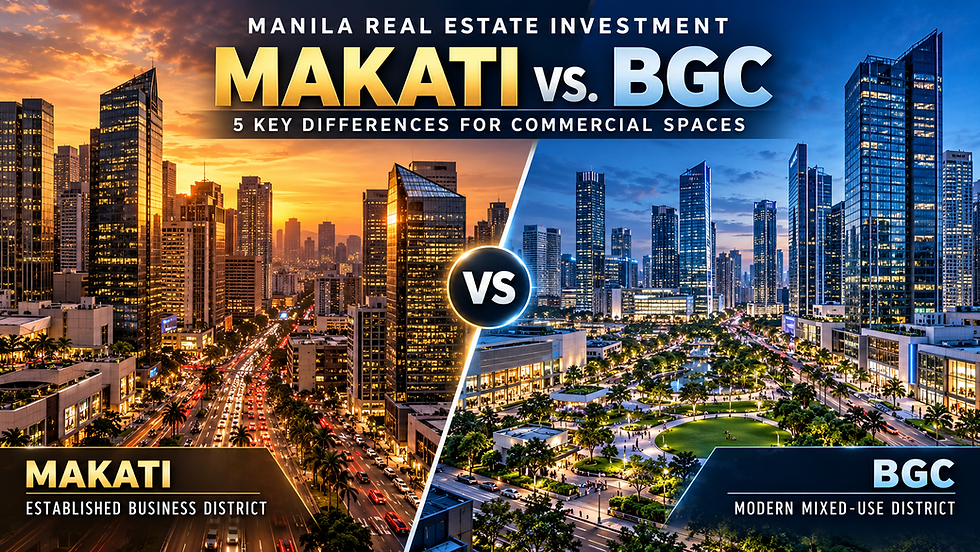
For businesses and investors considering Manila real estate investment, two locations consistently stand out: Makati Central Business District and Bonifacio Global City (BGC).
Both are major commercial centers in Metro Manila, but they offer noticeably different environments for offices, restaurants, retail stores, clinics, service businesses, and other commercial operations. Makati is an established financial district with decades of corporate activity behind it, while BGC has developed as a newer, master-planned business and lifestyle district.
The difference matters when choosing a commercial property.
Location affects much more than the price of a commercial space. It can influence the type of customers a business attracts, accessibility for employees, surrounding competition, rental conditions, visibility, and even how easily a company can expand later.
The Metro Manila office market has also been changing. In Q1 2026, Makati recorded approximately 77,900 square meters of office transactions, while BGC recorded about 27,700 square meters, according to Leechiu Property Consultants. At the same time, both districts continued to show relatively tight office availability compared with many other Metro Manila locations.
So, when comparing Makati vs. BGC commercial spaces, which characteristics should investors and businesses pay attention to?
Here are five important differences.
1. Business Environment: Established Makati vs. Master-Planned BGC

One of the clearest differences between Makati and BGC is how the two business districts developed.
Makati: A Long-Established Business Center
Makati has been one of the Philippines' principal financial and corporate centers for decades.
Ayala Avenue and the surrounding Makati CBD contain offices occupied by banks, professional-service companies, multinational corporations, embassies, law firms, financial institutions, hotels, restaurants, and retail establishments.
This mature commercial ecosystem can benefit businesses that depend on established corporate networks.
Professional services, financial companies, restaurants catering to office workers, convenience retailers, clinics, and service businesses may benefit from being surrounded by a large concentration of existing companies and employees.
The strength of current demand is visible in recent leasing activity. Leechiu reported that 63% of Makati's Q1 2026 office deals took place along Ayala Avenue, with many transactions involving fitted or semi-fitted spaces.
BGC: A Modern Mixed-Use District
BGC offers a different environment.
The district was developed around modern offices, condominiums, shopping centers, restaurants, international schools, medical facilities, parks, and pedestrian-oriented commercial areas.
Instead of functioning primarily as an office district, many areas within BGC combine business, residential, retail, and lifestyle uses.
For commercial tenants, this creates opportunities to serve several customer groups at once: office employees during weekdays, residents throughout the week, and leisure visitors during evenings and weekends.
Commercial advantage:Makati may appeal to businesses that want proximity to an established corporate ecosystem, while BGC can be attractive to businesses that benefit from a newer mixed-use environment.
2. Office Demand and Commercial Space Availability

Availability is an important consideration because a popular business district does not necessarily provide a large selection of commercial properties.
Metro Manila's overall office vacancy rate stood at approximately 19% in Q1 2026, according to Colliers. However, conditions inside prime CBDs were significantly tighter.
Leechiu reported vacancy of around 9% in Makati CBD and approximately 8% in BGC during Q1 2026.
This means companies looking for large, high-quality spaces in either district may face fewer choices than they would in areas with higher vacancy.
Why This Matters to Commercial Investors
Lower availability can benefit existing property owners because companies searching for space have fewer alternatives.
However, it can create challenges for tenants.
A company needing several consecutive floors, a particular building specification, parking allocation, restaurant exhaust provisions, or specialized electrical capacity may need to search earlier.
Colliers has advised occupiers to secure suitable office space early, particularly when targeting prime CBD locations where high-quality availability can be limited.
For investors, this makes the exact building just as important as the district.
Two properties located only a few streets apart can perform differently depending on building age, tenant profile, parking, floor efficiency, management, frontage, and technical specifications.
3. Customer Profile and Commercial Foot Traffic

Commercial property should not be evaluated only according to floor area and price.
Who actually spends time in the surrounding neighborhood?
This question becomes particularly important for restaurants, cafés, convenience stores, clinics, salons, fitness businesses, and other customer-facing commercial establishments.
Makati Commercial Market
Makati's customer base includes:
Corporate employees
Bank and financial-sector workers
Professionals
Condominium residents
Hotel guests
Foreign residents and expatriates
Shoppers and restaurant customers
Areas such as Ayala Avenue, Salcedo Village, Legazpi Village, Greenbelt, and nearby commercial streets can each attract slightly different customer profiles.
For example, a restaurant near an office cluster may generate strong weekday lunch demand but experience different traffic patterns during weekends.
BGC Commercial Market
BGC combines office workers with a substantial residential and lifestyle population.
Areas around High Street and major mixed-use developments can remain active outside standard office hours because customers may also be visiting restaurants, malls, parks, fitness facilities, hotels, entertainment venues, or residences.
This can be especially relevant for businesses that depend on evening and weekend customers.
Commercial Investment Lesson
Instead of simply asking whether Makati or BGC is better, investors should identify the intended customer first.
For example:
Corporate services: proximity to large office occupiers may matter more.
Restaurant or café: daytime population, residential density, visibility, and evening traffic may be more important.
Clinic or wellness business: residential population, parking, accessibility, and nearby offices may all influence demand.
Retail: frontage and pedestrian activity can become more important than the district name itself.
A prestigious address cannot compensate for a location that does not match the business's actual customers.
4. Accessibility and Employee Convenience

Accessibility is another major factor when comparing Makati vs. BGC commercial properties.
Makati Accessibility
Makati benefits from its central position within Metro Manila and its connection to major roads including EDSA, Ayala Avenue, Buendia, and surrounding transportation corridors.
Its established business district also places offices close to malls, hotels, restaurants, banks, residential buildings and transportation options.
For companies whose employees travel from different parts of Metro Manila, transportation accessibility can have a direct effect on recruitment, punctuality and employee satisfaction.
Colliers specifically recommends prioritizing transit-oriented locations, noting that accessibility supports return-to-office strategies and long-term workplace resilience.
BGC Accessibility
BGC is connected to Makati and other parts of Metro Manila through major roads including C5, McKinley Road, Kalayaan Avenue, and routes toward EDSA.
Inside the district, the master-planned environment provides modern roads, pedestrian areas, offices, retail establishments, parks, and residential developments within relatively concentrated zones.
However, businesses should still evaluate the commuting patterns of their actual workforce rather than assuming one CBD will automatically be more convenient.
Investor Consideration
Accessibility matters differently depending on the property type.
For an office investor, employee commuting may be one of the most important considerations.
For a restaurant, storefront visibility and pedestrian access may matter more.
For a medical clinic, parking and ease of drop-off may become essential.
Commercial investors should therefore evaluate accessibility from the perspective of the property's likely tenant or customer.
5. Property Type, Building Quality, and Long-Term Investment Strategy
The final difference involves the type of investment opportunity available.
Makati: Established Buildings and Redevelopment
Because Makati is an older CBD, its property market contains buildings from several generations.
Investors may encounter older commercial buildings alongside premium modern towers and recently renovated properties.
This creates different investment strategies.
An older unit may offer a different entry price but could require renovation or building-system upgrades. A newer Grade A building may command higher pricing but provide more modern facilities and stronger appeal to certain corporate tenants.
Makati itself is also going through another phase of redevelopment.
Colliers has noted that limited supply of high-quality office space has supported tighter conditions in Makati CBD, while major corporate headquarters and redevelopment projects are expected to reshape parts of the district over the coming years.
BGC: Modern Commercial Inventory
Because much of BGC was developed more recently, investors frequently encounter newer office towers and mixed-use projects.
Many buildings were designed for modern corporate tenants and may provide features such as efficient floor plates, contemporary building systems, sustainability certifications, modern common areas, and integrated retail components.
However, newer does not automatically mean more profitable.
Acquisition price, rental rate, vacancy risk, association dues, property taxes, fit-out costs, lease terms, and expected rental yield must still be considered.
Compare the Property, Not Just the CBD
An investor should therefore avoid making a purchase based simply on the label Makati or BGC.
The individual property remains critical.
A well-positioned commercial property in Makati can perform very differently from an older property several blocks away. The same principle applies in BGC.
Makati vs. BGC Commercial Property Comparison
Feature | Makati | BGC |
Business District | Long-established financial and corporate center | Newer master-planned business district |
Commercial Environment | Strong corporate and professional-services ecosystem | Strong combination of corporate, residential, retail, and lifestyle uses |
Building Inventory | Mix of older buildings, renovated assets, and modern premium towers | Generally newer commercial and mixed-use developments |
Customer Base | Corporate employees, professionals, residents, hotel guests, shoppers | Corporate employees, residents, shoppers, families, and lifestyle visitors |
Investment Consideration | Established location with redevelopment opportunities | Modern inventory within a growing mixed-use environment |
Best Evaluated By | Building condition, accessibility, tenant profile, pricing | Building specifications, location within BGC, pricing, tenant profile |
Neither district should automatically be considered superior. The better location depends on the intended commercial use, property specifications, acquisition cost, tenant market, and investment strategy.
What Commercial Property Investors Should Check Before Buying
Before investing in commercial real estate in Makati, BGC, or elsewhere in Metro Manila, investors should examine more than the selling price.
Important factors include:
Exact micro-location – Is the property close to offices, residences, transportation, malls, or major roads?
Target tenant – Who is likely to rent the property?
Building condition – How old are the major building systems?
Permitted commercial use – Can the intended business legally and technically operate from the unit?
Rental market – What are comparable spaces actually being offered or leased for?
Vacancy and competition – How many competing properties are available nearby?
Association dues and operating expenses – Higher monthly costs can reduce investment returns.
Parking – Parking can significantly affect certain commercial tenants.
Fit-out requirements – Restaurants, clinics, salons, and specialty businesses can require substantial mechanical, electrical, plumbing, ventilation, or fire-protection work.
Exit strategy – Consider both future leasing potential and resale demand.
For restaurant spaces in particular, investors should also verify exhaust provisions, grease traps, electrical capacity, drainage, water supply, LPG restrictions, fire safety requirements, and building fit-out regulations before committing to the property.
Makati or BGC: Which Commercial Location Fits Your Investment?
Choosing between Makati and BGC is ultimately less about identifying one universally better district and more about matching the property to the investment objective.
Makati provides access to one of Metro Manila's longest-established corporate and financial ecosystems. Recent office leasing activity also shows continued occupier interest, with Makati recording particularly strong transactions in early 2026.
BGC, meanwhile, offers a modern mixed-use environment combining offices, residences, restaurants, retail establishments, healthcare, recreation, and lifestyle destinations. Its relatively tight office vacancy also indicates limited available inventory within the district.
For investors, the most effective approach is to compare individual properties using actual numbers.
Purchase price, achievable rent, vacancy risk, operating costs, property condition, tenant demand, and future development should all be considered before making a decision.
A recognizable business address can attract attention, but successful Manila real estate investment ultimately depends on whether the commercial space fits the needs of its future occupants.
Frequently Asked Questions
Is Makati or BGC better for commercial property investment?
Both districts have different strengths. Makati has a long-established corporate and financial ecosystem, while BGC combines modern offices with residential, retail, and lifestyle developments. Investors should compare the individual property, target tenant, price, potential rent, and operating expenses instead of choosing based solely on the district.
Is Makati still a good location for office investment?
Makati continues to attract significant office demand. Leechiu Property Consultants reported approximately 77,900 square meters of transactions in Makati during Q1 2026, with much of the activity concentrated around Ayala Avenue.
Why do companies choose BGC for office space? Companies may consider BGC because of its modern office inventory, mixed-use environment, concentration of corporate occupiers, nearby residences, retail facilities, and lifestyle amenities. The suitability still depends on employee location, budget, building requirements, and available space.
What should I check before buying a commercial unit in Metro Manila?
Check the purchase price, comparable rental rates, permitted property use, tenant demand, building condition, association dues, parking, property taxes, fit-out requirements, vacancy levels, and potential resale market.
Can commercial spaces in Makati or BGC be used for restaurants?
Some can, but not every commercial unit is technically suitable for restaurant use. Investors should confirm building regulations and requirements for exhaust systems, grease traps, drainage, electrical load, water supply, fire protection, LPG use, waste disposal, and fit-out approval before purchasing or leasing.


コメント