Manila Commercial Spaces: 5 Features That Make Office Spaces More Marketable
A good office space does more than provide desks, walls, and an address.
For businesses, the workplace can affect employee productivity, recruitment, client experience, operating costs, expansion plans, and even how easily staff return to the office.
That is why the most marketable Manila Commercial Spaces are usually the ones that help businesses operate efficiently from the first day of occupancy.
This matters in the current Metro Manila office market.
Colliers reported that overall Metro Manila office vacancy remained at around 19% in Q2 2026, while leasing transactions declined quarter-on-quarter as companies became more cautious. At the same time, flexible workspace demand doubled year-on-year, and green-certified buildings accounted for 68% of office transactions during the first half of 2026.
Cushman & Wakefield also reported that Prime and Grade A office vacancy stood at 17.6% in Q2 2026, while occupiers increasingly considered secondary business districts offering larger floor plates and more competitive rental rates.
For office owners, landlords, and commercial property investors, this creates an important question:
What makes one office unit easier to market than another?
Price matters—but price alone is not enough.
Here are five features that can make an office property more competitive to serious business tenants.
1. A Flexible and Efficient Office Layout
The first question many businesses ask is not simply:
“How large is the office?”
It is:
“Can this space actually work for our team?”
Two office units with the same floor area can feel completely different depending on the layout.
An effective office should allow businesses to organize areas such as:
Workstations
Private offices
Meeting rooms
Reception
Pantry
Storage
Collaboration areas
Server or IT space
Employee breakout areas
A poorly designed floor plan can reduce usable space and increase fit-out costs.
For example, an office with too many fixed walls, narrow corridors, awkward columns, or an inefficient shape may require significant modification before a tenant can use it.
A more open and flexible floor plate gives companies greater freedom to adapt the office to their own operations.
This has become increasingly relevant as businesses reconsider how much office space they actually need.
Colliers reported that flexible workspace was one of Metro Manila's strongest office performers in Q2 2026, with net take-up doubling year-on-year as companies prioritized flexibility and scalability.
Property Owner Check
Ask:
Can this office accommodate different business sizes and working styles without requiring a major rebuild?
The easier it is to adapt the space, the broader the potential tenant market becomes.

2. Reliable Building Infrastructure and Office Readiness
A beautiful office is difficult to market if the building cannot reliably support everyday business operations.
Businesses may evaluate infrastructure such as:
Electrical capacity
Backup power
Air-conditioning
Internet and telecom readiness
Elevators
Fire protection systems
Building security
Water supply
Emergency systems
Loading and service access
For many professional, technology, outsourcing, and corporate occupiers, uninterrupted operations are essential.
An office that experiences unreliable elevators, weak internet connectivity, inconsistent cooling, or frequent power interruptions may become less attractive regardless of its interior design.
This is one reason Prime and Grade A office properties continue to attract stronger demand.
Cushman & Wakefield's 2026 outlook notes an ongoing flight to quality, with businesses continuing to favor Prime and Grade A buildings in major CBDs such as Makati, BGC, and Ortigas.
Its Q2 2026 investment report also notes that prime office assets maintained a more stable outlook, supported partly by tenant demand for better-quality buildings and enhanced amenities.
Property Owner Check
Before marketing an office as “business-ready,” verify exactly what infrastructure the building provides.
The more operational concerns a tenant can eliminate before move-in, the stronger the leasing proposition becomes.

3. Professional Building Quality and Sustainability
Office tenants are increasingly evaluating more than appearance.
Businesses are also asking whether the building is efficient, sustainable, professionally managed, and appropriate for their corporate standards.
This may include:
Green building certifications
Energy-efficient systems
Reliable building maintenance
Professional property management
Waste-management practices
Indoor air quality
Efficient lighting
Modern mechanical systems
Well-maintained common areas
Sustainability is becoming a meaningful leasing factor in Metro Manila.
Colliers reported that green-certified buildings represented 68% of office transactions during H1 2026, showing that sustainability is increasingly influencing occupier decisions.
For multinational firms, ESG-focused companies, IT-BPM occupiers, and larger corporations, the quality of the building can also affect internal real-estate standards and employee expectations.
A tenant may therefore prefer a slightly more expensive office in a professionally managed, efficient building over a cheaper unit that creates higher operational concerns.
Property Owner Check
Ask:
Does the building give a professional company confidence that it can operate here for several years?
Marketability depends not only on the individual office unit but also on the performance and reputation of the building around it.

4. Move-In Readiness and Lower Fit-Out Burden
Office tenants often calculate more than the monthly rent.
They also consider:
Construction
Partitions
Flooring
Lighting
Furniture
Electrical work
Internet installation
Meeting rooms
Pantry installation
Air-conditioning modifications
Permits
Project management
Time before operations can begin
An office that looks inexpensive may become costly once these requirements are added.
That is why move-in-ready or partially fitted office spaces can be attractive.
Depending on the tenant, valuable existing improvements may include:
Quality flooring
Ceiling and lighting
Meeting rooms
Pantry
Reception
Cabling
Workstations
Air-conditioning
Glass partitions
Storage
However, existing fit-out must still be useful.
An extremely customized office may only appeal to a narrow group of tenants.
The strongest spaces often provide enough existing infrastructure to reduce cost while remaining flexible enough for a new occupier to customize.
Example:
Office A
Lower rent
Bare shell
Major fit-out required
Longer setup period
Office B
Slightly higher rent
Existing meeting rooms
Lighting and flooring complete
Internet cabling ready
Can operate sooner
Office B may provide better overall value because the business can reduce capital expenditure and start operations more quickly.
Property Owner Check
Ask:
How much money and time would a new tenant need before employees can actually work here?
The lower the operational barrier to occupancy, the easier the property may be to market.

5. Lease Terms That Support Business Flexibility
A marketable office space needs more than physical features.
The commercial terms also need to make sense.
Businesses may consider:
Monthly rental rate
Security deposit
Advance rent
Lease duration
Fit-out period
Rent-free period
Escalation rate
Renewal options
Expansion options
Parking costs
Association or common-area charges
Restoration requirements
This is particularly relevant in the current Metro Manila market.
Cushman & Wakefield describes market conditions as broadly tenant-favorable, especially in secondary office locations where tenants may have more negotiating leverage.
Colliers likewise advises businesses to evaluate flexible and managed workspace solutions as companies prioritize scalability and lower capital requirements.
For a landlord, this does not mean simply reducing rent.
A thoughtful lease structure may sometimes create more value than the lowest headline rental rate.
Example
A tenant may prefer:
₱950/sqm with a practical fit-out period and reasonable escalation
instead of:
₱900/sqm with immediate rent commencement and rigid renewal terms
because the first option may better support the company's real operating needs.
Property Owner Check
Ask:
Do the lease terms make it easier for a serious business to invest in the space and remain for the long term?
Good commercial terms can turn interest into commitment.

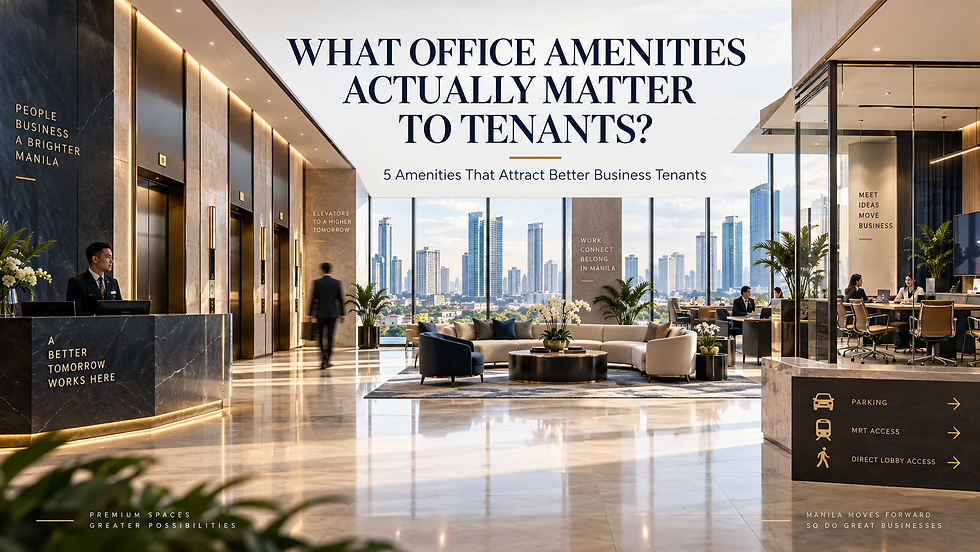
What About Office Amenities?
Amenities deserve their own evaluation because they influence employee experience and building competitiveness.
Important office amenities can include:
Reliable elevators
Professional lobby and reception
24/7 security
Backup power
Parking
Bicycle parking
Shower facilities
Meeting or conference facilities
Tenant lounges
Food and retail options
Outdoor areas
Fitness facilities
EV charging
Visitor management
Building apps or smart access systems
However, not every tenant values every amenity equally.
A BPO company may prioritize backup power and 24/7 access.
A professional services firm may care more about lobby quality, meeting facilities, and client experience.
A technology company may prioritize connectivity, flexible common spaces, and employee amenities.
This is why amenities should be evaluated according to the target tenant—not simply by counting how many facilities the building offers.
Recommended Supporting Blog:Manila Commercial Spaces: 5 Office Amenities That Attract Better Business Tenants
What About Location and Access?
Office location is another major topic that deserves separate consideration.
Tenants may evaluate:
Proximity to business districts
Public transportation
Major roads
Employee commute
Client accessibility
Parking
Restaurants and retail
Banks
Hotels
Residential communities
Airport accessibility
Colliers specifically recommends that occupiers prioritize transit-oriented locations, noting that accessibility can support return-to-office strategies and employee retention.
Location strategy is also becoming more nuanced.
Cushman & Wakefield reported that some occupiers increasingly considered fringe or secondary CBD locations in Q2 2026 because they can offer larger contiguous office spaces and more competitive rental rates.
Therefore, “prime location” should not simply mean the most expensive address.
The better question is:
Does the location make business operations easier for employees, clients, and management?
Recommended Supporting Blog:Manila Commercial Spaces: 5 Location Features That Attract Office Tenants
Manila Commercial Spaces: Marketable Offices Solve Business Problems
A marketable office is not necessarily the newest or most expensive space.
The strongest commercial properties usually make business operations easier.
They combine:
**Flexible Layout
Reliable Infrastructure
Quality Building Management
Lower Fit-Out Burden
Practical Lease Terms**
Current market data supports this shift toward quality and flexibility.
Flexible workspace demand doubled year-on-year in Q2 2026, green-certified buildings accounted for 68% of H1 transactions, and businesses continue to favor Prime and Grade A properties while also exploring cost-effective secondary locations.
For owners of Manila Commercial Spaces, the objective should therefore not simply be:
“How can I advertise this office?”
A stronger question is:
“What business problems does this office solve better than the alternatives?”
That is what makes an office property genuinely marketable.
Do You Have an Office Space for Sale or Lease?
BedandGo Inc. Can Help Position Your Commercial Property
BedandGo Inc. assists owners and investors with commercial property opportunities across Metro Manila.
When preparing an office space for the market, important considerations may include:
Floor area
Layout
Current condition
Existing fit-out
Building grade
Infrastructure
Rental or selling price
Lease terms
Amenities
Parking
Location
Transportation access
Target business tenant
Whether your office property is located in Makati, BGC, Manila, Pasay, Pasig, Ortigas, Quezon City, Parañaque, Alabang, or another Metro Manila business area, strong positioning can help serious tenants and buyers understand the property's commercial value.
Looking to market an office space?
Contact BedandGo Inc. with the location, floor area, current condition, asking price or rental rate, and available property details.
REB License No. 0005171
Frequently Asked Questions
What makes an office space more marketable?
A marketable office usually offers an efficient layout, reliable building infrastructure, professional management, manageable fit-out requirements, and practical commercial terms. Location and amenities also influence tenant demand.
Are fitted office spaces easier to lease?
They can be, especially if the existing fit-out reduces construction costs and allows faster occupancy. However, highly specialized layouts may appeal to fewer tenants.
Do businesses still prefer Grade A office buildings?
Prime and Grade A properties continue to benefit from flight-to-quality trends. Businesses often prefer properties with reliable infrastructure, sustainability credentials, better amenities, and professional management.
Is Metro Manila currently favorable for office tenants?
conditions remain relatively tenant-friendly. Cushman & Wakefield reported Prime and Grade A vacancy of 17.6% in Q2 2026, while overall competition continues to give occupiers opportunities to negotiate terms.
Are sustainable office buildings becoming more important?
Yes. Colliers reported that green-certified buildings represented 68% of Metro Manila office transactions during the first half of 2026.
Is location more important than amenities?
Both matter, but their importance varies by tenant. Location affects employee and client accessibility, while amenities influence convenience and workplace experience. For SEO and clarity, they are strong topics for separate supporting articles.
Can BedandGo help market office space?
Yes. BedandGo Inc. can assist owners with commercial property marketing, inquiries, viewings, and sales or leasing opportunities.


コメント