


Manila Real Estate Supply Pipeline Q1 2026: 5 Positive Signs from New Housing Permit Data
- bedandgoinc
- 15 時間前
- 読了時間: 6分
更新日:2 時間前
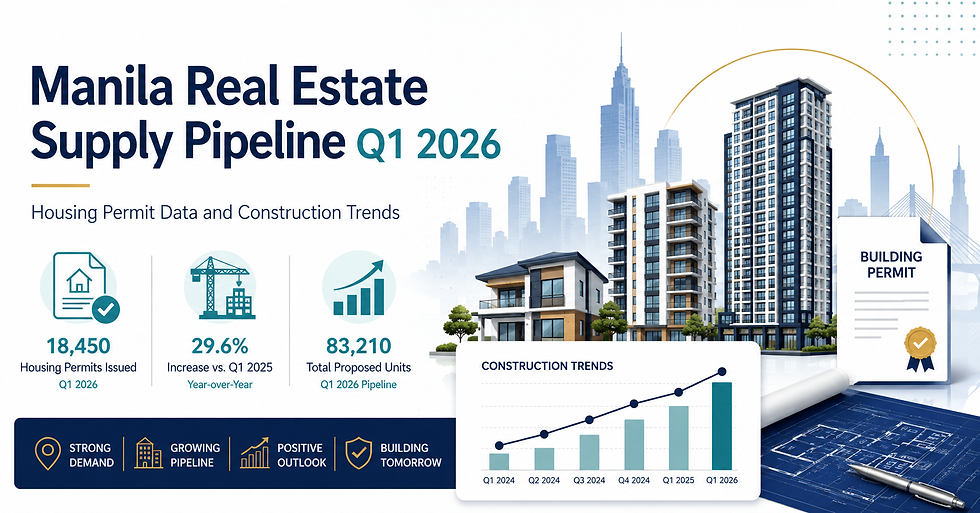
When people talk about Manila real estate, they often look first at prices, rental rates, or available condo listings. These are important, but they are not the only signals that matter.
One useful early indicator is building permit data.
Before new homes, condominiums, commercial buildings, or mixed-use projects are built, they usually appear first in approved building permit statistics. This makes permit data useful for understanding the future supply pipeline. It does not show completed units yet, but it gives buyers, sellers, and investors an early look at where construction activity may be heading.
For Q1 2026, the Philippine Statistics Authority data shows a mixed but useful picture. Construction activity did not move in a straight line, but the overall quarter still showed steady permit volume, continued residential activity, higher construction value in some months, and important signals about future supply.
This Manila Real Estate Supply Pipeline Q1 2026 update explains five positive signs from new housing permit data and what they may mean for property buyers, condo owners, and investors watching Metro Manila.
Why Manila Real Estate Supply Pipeline Q1 2026 Matters
The Manila real estate supply pipeline matters because today’s building permits can become tomorrow’s supply. A permit does not mean the project is completed, but it shows that a project has moved into the approved construction stage.
For investors, this helps answer important questions:
Is new supply still entering the market?
Are residential projects still active?
Are developers moving carefully or aggressively?
Are construction costs rising?
Will future supply compete with existing condo units?
In Q1 2026, PSA data shows that approved constructions remained active across January, February, and March. January recorded 13,577 approved constructions, February recorded 14,996, and March recorded 16,066. Combined, this points to a steady first-quarter construction pipeline.
This is useful because it gives investors more than just a price headline. It helps show what could enter the market later.
1. Approved Construction Activity Remained Steady in Q1
One positive sign is that approved construction activity continued throughout the first quarter.
The number of approved constructions reached 13,577 in January, 14,996 in February, and 16,066 in March. March also posted a 2.0% annual increase compared with March 2025.
This is important because construction permits are an early sign of developer and owner activity. A steady number of permits suggests that construction planning did not stop, even while the market remained selective.
For real estate investors, this means the market still has movement. Developers, owners, and builders are still applying for approved projects, even if they are becoming more careful about cost, demand, and location.
The takeaway: The supply pipeline is still active. The market is not frozen, but investors should still compare which property types and locations are getting approvals.
2. Residential Buildings Continued to Lead the Number of Approvals

Residential buildings remained the biggest share of approved constructions during the quarter.
In January, residential buildings accounted for 8,156 approved constructions. In February, they reached 9,273. In March, they reached 9,955, equal to 62.0% of total March approvals.
This is a positive sign because residential demand remains central to the construction market. Even when total activity changes from month to month, housing-related approvals continue to make up the largest portion of approved construction activity.
For Manila real estate investors, this matters because residential supply is directly connected to housing demand, rental demand, resale activity, and future competition. If residential projects remain active, it shows that builders still see demand for housing.
However, investors should not read this as a simple “buy anywhere” signal. Residential approvals include different types of housing, such as single-type houses and residential condominium projects. The quality, location, and target market still matter.
The takeaway: Housing remains a key part of the Philippine construction pipeline, but investors should still look at the exact property type and location before making decisions.
3. March Showed a Positive Turn in Residential Construction Value
Another positive sign is that residential construction value improved in March.
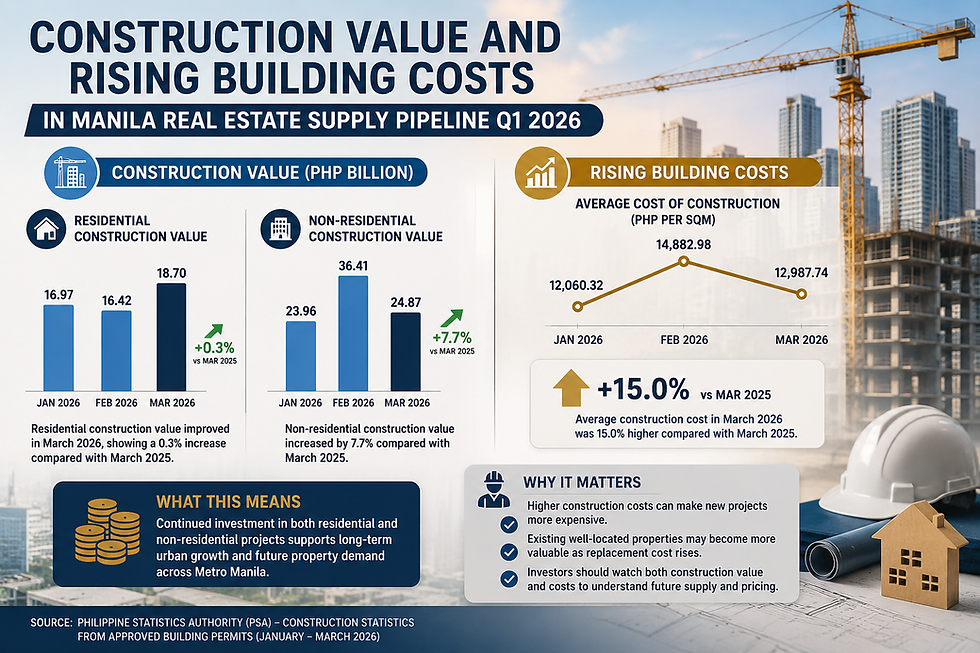
In January 2026, residential construction value was about PHP 16.97 billion. In February, it was about PHP 16.42 billion. By March, it reached about PHP 18.70 billion, showing a small annual increase of 0.3% compared with March 2025.
This matters because value gives a different signal from the number of permits. A month can have many permits, but if construction value is weak, it may suggest smaller or lower-cost projects. When value improves, it can point to more meaningful construction spending.
For investors, this suggests that residential construction remained financially active by the end of the quarter. It also helps show that the housing sector still attracts capital, even in a more selective market.
The takeaway: Residential construction value improved by March, giving a cautious but positive signal for housing activity.
4. Non-Residential Value Added Support to the Wider Property Market
Real estate is not only about housing. Offices, commercial spaces, institutional buildings, and other non-residential projects also affect property demand.
In February 2026, non-residential construction value increased strongly year-on-year, reaching about PHP 36.41 billion. In March 2026, non-residential construction value was about PHP 24.87 billion, up 7.7% from March 2025.
This is useful for Manila real estate investors because commercial and institutional construction can support surrounding residential demand. When business, education, healthcare, and institutional projects continue, they can help create jobs, movement, and future housing needs nearby.
For example, areas with active office, commercial, or institutional growth may later support rental demand from workers, students, professionals, or families who want to live nearby.
The takeaway: Non-residential construction value can indirectly support residential real estate by strengthening the wider urban environment around housing.
5. Rising Construction Costs Can Support Existing Property Value

Construction costs are another important signal.
PSA reported the average cost of construction at PHP 12,060.32 per sqm in January, PHP 14,882.98 per sqm in February, and PHP 12,987.74 per sqm in March. In March, the average cost was 15.0% higher than March 2025.
For buyers, higher construction costs can be a warning because future projects may become more expensive to build. Developers may need to price new units carefully to protect margins.
For existing condo owners, however, this can be a positive support factor. If new projects become more expensive to construct, existing well-located units may look more competitive, especially if they are already ready for occupancy, properly maintained, and priced realistically.
This does not mean prices will automatically rise. But rising construction costs can make replacement supply more expensive, which is important when comparing old and new units.
The takeaway: Higher construction costs may support the long-term value of existing well-located properties, especially in strong rental and resale areas.
What This Means for Buyers
For buyers, Q1 2026 permit data shows that new supply is still coming, but it is not uniform. Some segments remain active, while others may be more cautious.
Before buying, check:
Current resale prices
Developer RFO promos
Building condition
Nearby future projects
Association dues
Parking availability
Rental demand
Construction activity in the area
A lower price is not always the best deal. A better choice may be a unit in a strong location, with good building management, clear tenant demand, and less direct future competition.
What This Means for Sellers
For sellers, active permit data means buyers may continue to compare many options. A resale unit must be priced and presented properly.
If new supply is expected in your area, your listing should be clear, competitive, and easy to understand. Strong photos, realistic pricing, complete details, and clear location benefits become even more important.
However, rising construction costs may also help sellers of existing units. If future projects become more expensive, a well-maintained existing unit can look more practical to buyers who want immediate use, rental income, or a lower entry price.
What This Means for Investors
For investors, the main lesson is to watch the supply pipeline, not only the selling price.
Approved building permits can show where future supply may come from. If many similar projects are being approved in one area, future competition may increase. If approvals are limited while demand remains steady, existing units may become more attractive.
Investors should focus on:
Locations with strong tenant demand
Buildings with good management
Practical unit layouts
Realistic pricing
Nearby business activity
Future supply risk
Construction cost trends
Easy resale or leasing potential
The best property investment is not only about buying early. It is about understanding what supply may enter the market later.
Final Thoughts: Building Permit Data Gives Early Market Signals
The Manila real estate market in Q1 2026 showed signs of continued activity, especially in residential construction approvals and wider property development value. The data does not show a simple boom, but it does show that the supply pipeline remains active.
For buyers, sellers, and investors, this is useful because building permits are early signals. They appear before new supply is completed, before units are turned over, and sometimes before market pressure is visible in prices.
The positive signs are clear: construction approvals continued, residential buildings remained the largest share, March residential value improved, non-residential investment supported the wider market, and rising construction costs may help support existing well-located properties.
For anyone watching Manila real estate in 2026, the key is to compare carefully. Look at permit data, actual listings, building condition, rental demand, and future supply together. A smart decision should be based not only on today’s price, but also on tomorrow’s pipeline.
Sources
Philippine Statistics Authority — Construction Statistics from Approved Building Permits January 2026https://psa.gov.ph/content/construction-statistics-approved-building-permits-january-2026
Philippine Statistics Authority — Construction Statistics from Approved Building Permits February 2026https://psa.gov.ph/content/construction-statistics-approved-building-permits-february-2026
Philippine Statistics Authority — Construction Statistics from Approved Building Permits March 2026https://psa.gov.ph/content/construction-statistics-approved-building-permits-march-2026



コメント