
The Evolving Commercial Real Estate Market in the Philippines: 2025 Outlook
Date: July 12,2025
The commercial real estate (CRE) market in the Philippines remains a vital component of the country’s economic engine, encompassing office buildings, retail spaces, logistics hubs, and industrial parks. Despite global disruptions and a period of pandemic-induced uncertainty, the sector is showing steady signs of recovery, driven by renewed investor confidence, REIT expansion, and infrastructure upgrades.

1. Key Market Trends in Philippine Commercial Real Estate
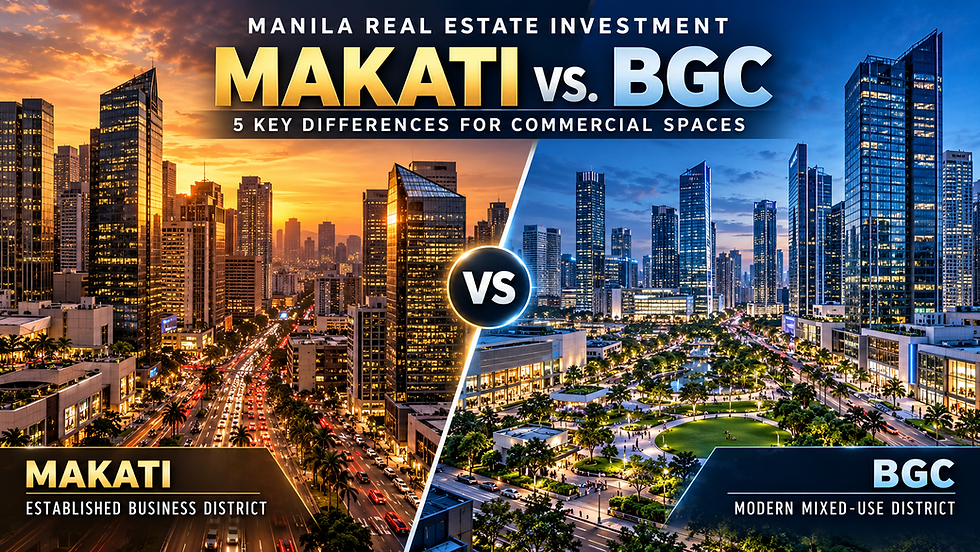
The commercial sector has regained momentum as business activity resumes and investor appetite returns. According to Colliers, Metro Manila’s total office stock reached over 13 million sqm in early 2025, with new completions concentrated in BGC, Makati, and the Bay Area.
Office Sector: Demand is slowly stabilizing. While hybrid setups have reduced the overall need for space, the flight to quality is clear—tenants prefer LEED-certified, flexible, and well-located buildings.
Retail Spaces: Traditional malls are recalibrating into lifestyle centers, incorporating entertainment, co-working zones, and F&B anchors to retain foot traffic amid e-commerce growth.
Industrial and Logistics: This is the sector to watch. Fueled by surging e-commerce and supply chain localization, warehouses and logistics parks near ports and key highways are in high demand.
Developers like Ayala Land, SM Prime, Megaworld, and Robinsons Land continue to lead the charge, alongside newer REIT players such as AREIT, RL Commercial REIT, and MREIT, which provide investors with stable income-generating options.
2. Pandemic's Lasting Impact on Commercial Real Estate
COVID-19 reshaped the CRE landscape, but the industry’s resilience is evident in its swift adaptations.
Office Demand Realignment: Vacancy rates peaked at over 17% in 2021 but have since tapered to under 12% by Q1 2025. Hybrid work remains, but sectors like BPOs, law firms, and financial services are re-expanding in prime CBDs.
Retail Recovery: Malls in urban centers are reporting footfall close to pre-pandemic levels, especially those that rebranded as mixed-use destinations.
Warehouse Surge: Logistics real estate boomed during the pandemic and remains strong, especially in Cavite, Bulacan, and Laguna where land is still relatively affordable.
Rental rates for Grade A office spaces have softened slightly but are stabilizing in top-tier buildings. Meanwhile, industrial lease rates continue to trend upward due to demand-supply mismatch.

3. Government Policies Driving Sector Growth
The Philippine government has accelerated infrastructure and regulatory reforms to support CRE growth:
REIT Expansion: The revised REIT law in 2020 and updated tax guidelines encouraged the listing of several REITs, providing capital access and liquidity to developers while offering retail investors exposure to CRE.
Build, Better, More Program: This updated infrastructure initiative (formerly Build, Build, Build) is enhancing connectivity across Metro Manila and key provincial hubs, boosting land values and commercial viability.
Investment Incentives: The Board of Investments (BOI) and PEZA continue to offer fiscal incentives for logistics, IT parks, and green-certified developments.
Policies are also aimed at streamlining permits and increasing transparency in property ownership—key factors for attracting foreign investors.
4. Challenges and Opportunities for CRE Stakeholders
Challenges:
Financing Constraints: Lending remains tight, especially for speculative commercial builds outside Metro Manila.
High Vacancy in Some Segments: Older, non-PEZA-certified buildings are facing increasing tenant churn and longer downtimes.
Complex Regulatory Landscape: Despite improvements, navigating zoning laws, local permits, and tax compliance remains time-consuming.
Opportunities:
Industrial Expansion: The booming e-commerce sector needs warehouses, cold storage, and last-mile delivery hubs.
Flexible and Green Offices: Tenants are willing to pay a premium for modern, eco-friendly, and tech-enabled spaces.
REIT Participation: Retail investors can now participate in the commercial property market through dividend-yielding REITs—creating a deeper, more liquid market.
Innovative mixed-use townships integrating residential, commercial, and lifestyle components—especially outside Metro Manila—are also gaining traction.

5. Strategic Considerations for Investors and Developers
To thrive in today's evolving CRE environment, stakeholders should:
Focus on High-Growth Sectors: Prioritize logistics, green buildings, and transit-oriented developments.
Build Partnerships: Collaborating with established players can reduce capital risk and ease compliance burdens.
Incorporate ESG: Sustainable buildings not only attract tenants but are increasingly favored by institutional investors and REITs.
Leverage Technology: Use proptech for asset management, tenant engagement, and data analytics to drive efficiencies and performance.
By aligning investments with the market's transformation, stakeholders can position themselves ahead of the curve.
The Philippine commercial real estate market is steadily moving into its next growth phase. Post-pandemic recalibrations, strong infrastructure support, REIT developments, and sustained demand in logistics and hybrid retail are reshaping the sector.
While challenges around vacancy, financing, and regulation persist, opportunities abound—particularly in warehousing, green offices, and mixed-use spaces. With smart strategies, strong partnerships, and a forward-looking approach, commercial property investors and developers can unlock long-term value in one of Southeast Asia’s most promising real estate markets.
Source:



コメント