
Manila Real Estate Investment: 5 Reasons Good Properties Still Struggle to Sell
A good property does not always become an easy sale. A condominium may be in a respected development. A house may be well maintained. An investment unit may have good access, attractive amenities, or strong rental potential—and still sit on the market without serious offers. That is one of the realities facing Manila real estate investment today.
Metro Manila’s residential market is showing signs of recovery, but buyers remain selective. Colliers reported in August 2026 that high vacancies and substantial unsold condominium inventory continue to affect the market, even as economic and affordable housing demand improves. Developers have also reduced new condominium launches while focusing on existing inventory.
JLL likewise reported positive residential absorption in Q2 2026, but capital values were still declining despite modest rental growth and slightly better vacancy.
This means sellers are competing for buyers who have more information, more alternatives, and stronger reasons to compare before committing.
Here are five reasons even good properties can struggle to sell.
1. The Property Is Good, but the Price Is Not Competitive
One of the biggest mistakes sellers make is assuming that a good property automatically deserves a premium price.
Owners often calculate value based on:
Original purchase price
Renovation expenses
Furniture and appliances
Years of ownership
Developer price increases
Expected appreciation
Personal attachment to the property
Buyers look at the property differently.
They ask: "What else can I buy with the same budget today?”
A buyer may compare your property against:
Similar resale units
Newly completed properties
Developer-owned RFO inventory
Properties with parking
Larger units
Furnished units
Properties with easier financing
Discounted listings
That comparison is especially important when capital values are under pressure. JLL reported that Manila residential capital values continued to decline in Q2 2026 even while absorption remained positive.
Seller Check
Do not ask only: "How much do I want to receive?”
Ask: "At this price, why would a buyer choose my property over the nearest alternatives?”
If that answer is unclear, the asking price may be working against the property.

2. Buyers Are More Sensitive to Financing and Total Cost
A property may look affordable based on its selling price, but buyers also consider how difficult it will be to complete the purchase.
Their actual financial commitment can include:
Down payment
Monthly amortization
Bank financing
Transfer expenses
Taxes
Association dues
Parking
Renovations
Furnishing
Repairs
Property management costs
A buyer may genuinely like a property but still delay the purchase because the overall financial commitment feels too high.
This is particularly relevant in a cautious residential market. Colliers describes Metro Manila’s recovery as fragile, despite improving absorption, because high vacancy, unsold inventory, affordability concerns, and financing conditions continue to influence purchasing decisions.
Example
Consider two similar properties.
Property A
₱8.5 million selling price
Parking sold separately
Requires renovation
Standard bank financing
Property B
₱8.8 million selling price
Parking included
Move-in ready
Seller is slightly negotiable
Property A appears cheaper at first.
But after the buyer calculates the full cost, Property B may feel like the better deal.
Seller Check
Think beyond the headline selling price.
Ask: "What will this purchase actually cost the buyer before they can comfortably use or rent the property?”
Reducing friction can sometimes matter more than reducing the advertised price.

3. Too Much Similar Inventory Makes Good Properties Look Ordinary
One of the hardest challenges in Manila real estate investment is differentiation.
Metro Manila still has substantial condominium inventory, and Colliers expects residential vacancy to peak at around 25.6% in 2026 before improving as completions slow from 2027 onward. The firm also notes that developers are prioritizing the disposal of unsold RFO inventory instead of aggressively launching new condominium projects.
For a seller, this creates a simple problem: The buyer may have too many similar choices.
Imagine a buyer searches within one neighborhood and finds:
Six 1-bedroom units
Similar floor areas
Similar amenities
Similar building age
Similar furnishings
Similar asking prices
Even if all six are good properties, none may feel particularly special.
The property that gets attention usually gives the buyer a clear reason to choose it.
That advantage could be:
Better view
Higher floor
Corner position
Parking included
Larger usable space
Balcony
Better renovation
Better furniture
Existing tenant
Strong rental history
More attractive price
Seller Check
Ask: "What can I say about this property that I cannot say about ten competing listings nearby?”
If the answer is only “good location” or “nice amenities,” stronger positioning may be needed.

4. The Property Is Being Marketed Like a Listing Instead of an Opportunity
A property can be good in person and still look weak online.
Today, many buyers eliminate properties before ever scheduling a viewing.
A listing may be ignored because of:
Dark photographs
Poor image quality
Repetitive photos
No clear selling price
Missing floor area
Incomplete specifications
No explanation of the location
Weak description
No parking information
No clear investment or lifestyle advantage
This becomes more important when buyers are comparing professionally marketed developer inventory with privately owned resale properties.
If the developer provides professional photography, attractive model units, detailed payment information, and clear promotional materials, a resale listing consisting of five dark cellphone photos immediately looks less competitive.
A Better Property Story
Instead of simply showing the unit, the listing should answer:
What is it?2BR condo, 68 sqm, high floor.
Where is it? Near a business district, school, hospital, transport connection, or commercial area.
Why is it attractive? Parking, balcony, open view, good layout, renovated interior, or strong rental suitability.
Who is it for? End-user, family, corporate tenant, investor, executive, or foreign buyer.
Seller Check
Look at the listing without thinking about what you already know about the property.
Ask: "Would someone understand the property's value within the first 10 seconds?”
If not, the presentation may be hiding a genuinely good opportunity.

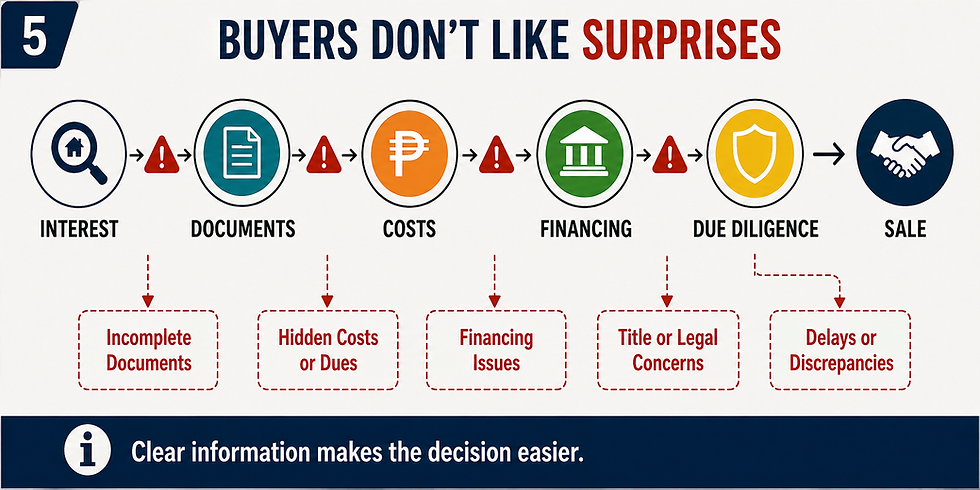
5. Buyers See Too Much Uncertainty Before the Sale Can Close
A buyer does not only buy the property. They also buy into the transaction.
A property can lose a serious buyer if questions begin appearing around:
Ownership documents
Outstanding association dues
Property taxes
Existing mortgage
Existing tenant
Parking ownership
Authority to sell
Renovation approvals
Transfer process
Building restrictions
Required payment schedule
Missing records
When competing properties are readily available, buyers may choose the transaction that feels easier and safer.
This is especially relevant in a selective market. Across Asia Pacific, Colliers reported in Q2 2026 that investors were becoming increasingly market-specific and continued to favor higher-quality assets amid global uncertainty.
The same underlying behavior can be seen at an individual buyer level:
When uncertainty rises, buyers demand clearer value and fewer complications.
Seller Check
Before seriously marketing the property, organize the documents likely to be requested during due diligence.
Depending on the transaction, these may include:
Condominium Certificate of Title or Transfer Certificate of Title
Tax Declaration
Real Property Tax records
Association dues records
Existing lease agreement
Valid seller identification
Parking documents
Corporate documents where applicable
Authorization documents where applicable
Exact requirements vary, so property owners should confirm transaction-specific requirements with appropriate real estate and legal professionals.
Manila Real Estate Investment: Why Quality Alone Does Not Guarantee a Sale
The current market demonstrates an important distinction: A good property and a marketable property are not always the same thing.
A property can have: Good location + good building + good condition
but still struggle when buyers see: High price + many alternatives + financing difficulty + weak presentation + transaction uncertainty
Current market reports support this more selective environment. Colliers expects Metro Manila residential vacancy to peak at 25.6% in 2026, while developers are reducing launches and concentrating on moving existing stock. At the same time, affordable housing is outperforming more expensive segments because affordability has become a major driver of demand.
JLL’s Q2 2026 report adds another layer: absorption remains positive, yet capital values are declining. For sellers, that means waiting for the market alone may not solve the problem.
A stronger question is: "What can I change about the price, presentation, positioning, or transaction to give the buyer a stronger reason to proceed?”
Planning to Sell Property in Metro Manila?
BedandGo Inc. Can Help Position Your Property
BedandGo Inc. assists owners who want to market residential investment properties across Metro Manila.
Before bringing a property to market, important factors can include:
Asking price
Comparable listings
Unit or property condition
Location
Furnishing
Parking
Floor and view
Building quality
Target buyer
Rental potential
Competing developer inventory
Whether your property is in Makati, BGC, Manila, Pasay, Pasig, Quezon City, Paranaque, Alabang, or another Metro Manila location, the goal is not simply to list the property. The goal is to make buyers understand why this particular property deserves consideration.
Planning to sell?
Contact BedandGo Inc. with your property location, selling price, floor area, property type, and current condition.
REB License No. 0005171
Frequently Asked Questions
Why do good properties still struggle to sell in Manila?
Even attractive properties can struggle because of high asking prices, competing inventory, financing concerns, weak listing presentation, or complicated transaction requirements.
Is Metro Manila currently a difficult market for property sellers?
Conditions vary by location and property type. The market is seeing improving absorption, but elevated residential vacancy and substantial unsold condominium inventory mean buyers continue to have significant choice.
Should I lower my property price if I am not receiving inquiries?
Not automatically. First compare the property against similar active listings, developer offers, location, condition, payment requirements, and presentation. Price may be the problem, but it may not be the only problem.
What makes one property easier to sell than another?
Competitive pricing, a strong location, useful property features, good presentation, clear documentation, easy viewing access, and a distinct advantage over competing listings can all help.
Does professional property marketing matter?
Yes. Buyers increasingly compare properties online before arranging viewings. Clear information and professional presentation can make it easier for them to understand the property's value.
Sources
Colliers Philippines — Q2 2026 Residential Property Market Report
Reports elevated vacancy, substantial unsold inventory, weaker launches, and stronger demand for affordable housing. Colliers Q2 2026 Residential Report
Colliers Philippines — Q1 2026 Residential Property Market Report
Reports improving inventory absorption but continued oversupply and market fragility. Colliers Q1 2026 Residential Report
JLL — Manila Residential Market Dynamics Q2 2026
Reports positive absorption, slightly improved vacancy, modest rental growth, and declining capital values. JLL Manila Residential Q2 2026
Colliers — Asia Pacific Cap Rates Report Q2 2026
Highlights increasingly selective investor behavior and continued preference for high-quality assets amid uncertainty. Colliers Asia Pacific Cap Rates Q2 2026



コメント