
First-Time Condo Buyer Guide 2026: 5 Positive Steps to Choose the Right Unit.
更新日:9月4日

Ready to start comparing locations and properties? Explore our guide to affordable condos for sale in Metro Manila for area-by-area considerations, resale versus RFO options and costs beyond the purchase price. Buying your first condo is exciting, but it can also feel confusing. There are many buildings, locations, prices, payment terms, fees, and documents to check. For first-time buyers, it is easy to focus only on the unit photos, the monthly payment, or the promise of a good location.
But choosing the right condo is not only about finding a nice-looking unit. It is about finding a unit that fits your budget, lifestyle, future plans, and long-term value.
In 2026, condo buyers in Metro Manila have more choices, especially in ready-for-occupancy and resale units. Some areas still have many unsold units, while prime locations and well-priced properties continue to attract serious buyers. This means first-time buyers should not rush. The good news is that with the right steps, you can compare units more clearly and make a more confident decision.
This First-Time Condo Buyer Guide 2026 explains five positive steps to help you choose the right unit before you buy.
Why a First-Time Condo Buyer Guide 2026 Matters
A First-Time Condo Buyer Guide 2026 is useful because the condo market is not the same in every area. A unit in Makati, BGC, Ortigas, Quezon City, Pasay, or Alabang can have a very different price, rental demand, building condition, and resale value.
For example, recent market reports show that Metro Manila still has unsold ready-for-occupancy condo units, which can give buyers more room to compare and negotiate. At the same time, some market updates show signs of recovery, especially in certain price segments and well-located projects.
This is why first-time buyers should avoid choosing based only on popularity. A famous area can still have overpriced units. A cheaper unit can still become expensive if the dues, repairs, or transfer costs are high.
The best first condo purchase starts with clear checking.
Step 1: Start With Your Real Purpose
Before you compare prices, ask one simple question:
Why am I buying this condo? Your purpose affects almost every decision.
You may be buying for:
Personal use
Long-term rental income
Future resale
Retirement
Temporary stay in the Philippines
A home for family members
A base near work or school
If you are buying for personal use, comfort and daily convenience matter more. You should check the commute, nearby groceries, hospitals, noise level, and building rules.
If you are buying for rental income, tenant demand matters more. You need to check if the area attracts workers, expats, students, or corporate tenants.
If you are buying for resale, location, building reputation, unit layout, and future demand are important.
Do not buy only because someone says the area is popular. A good condo is one that fits your actual plan.
Step 2: Compare the Location, Not Just the Building
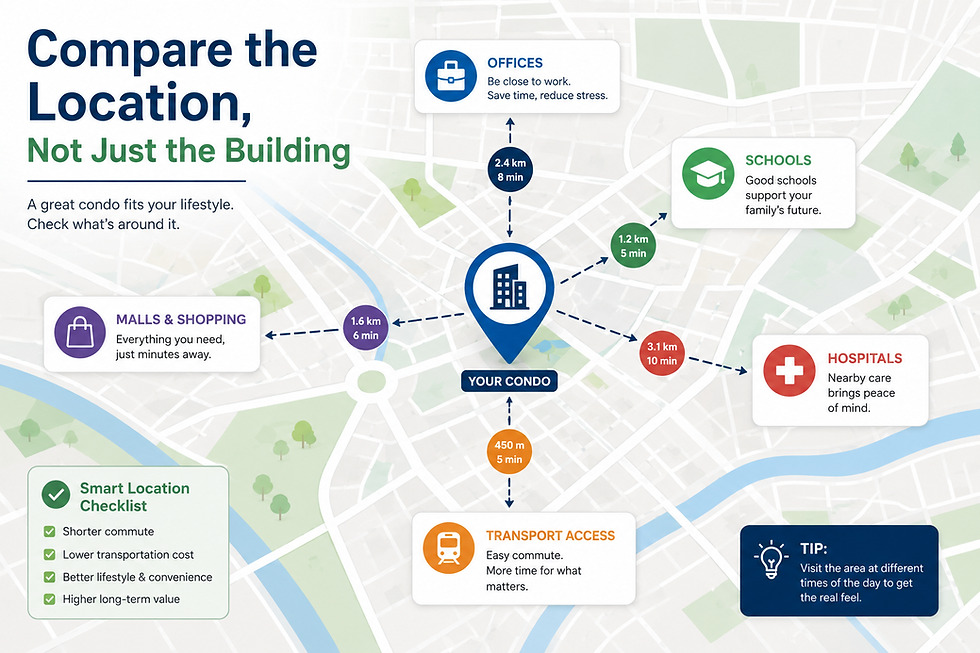
Location is one of the biggest factors in condo value. But location does not only mean the city name. It means the exact street, nearby establishments, transport access, and the building’s position within the area.
Before choosing a unit, check what is around it:
Offices and business districts
Schools and universities
Hospitals and clinics
Supermarkets and malls
Public transport or main roads
Restaurants and daily services
Future infrastructure projects
For example, a unit near Makati CBD may appeal to business professionals. A unit near BGC may appeal to expats and corporate tenants. A unit near a university may attract students or young professionals.
Also check traffic and daily movement. A condo that looks near everything on the map may still feel inconvenient if access roads are difficult or traffic is heavy.
For first-time buyers, it helps to visit the area at different times of the day. Check the area in the morning, afternoon, and evening. This gives you a better feel for noise, traffic, safety, and convenience.
Step 3: Check the Full Cost, Not Only the Selling Price

Many first-time buyers focus only on the unit price. But the real cost of buying a condo includes more than the listed amount.
You should prepare for:
Reservation fee
Down payment
Balance payment
Documentary stamp tax
Transfer tax
Registration fees
Notarial fees
Association dues
Move-in fees
Utility deposits
Repairs or furnishing costs
In the Philippines, closing and transfer-related costs can add a significant amount to the purchase. Some guides estimate that total closing costs can reach around 8% to 10% of the property value, depending on the transaction and who pays which fees.
This is why you should always ask for a full sample computation before agreeing to buy.
Do not rely only on the headline price.
Also check monthly costs after purchase. A unit may seem affordable at first, but high association dues, parking fees, repairs, or furniture costs can affect your budget.
A good first condo purchase should feel manageable not only on day one, but also every month after you own it.
Step 4: Inspect the Unit and the Building Carefully

Photos are helpful, but they are not enough. Before buying a ready-for-occupancy or resale condo, always inspect the unit in person if possible. If you are overseas, ask a trusted representative or real estate team to inspect it for you.
During inspection, check:
Water leaks
Aircon condition
Electrical outlets
Water pressure
Bathroom drainage
Kitchen condition
Door locks and windows
Wall cracks or stains
Floor condition
Smell, ventilation, and natural light
You should also check the building, not only the unit.
Look at the elevators, lobby, hallways, security, amenities, parking, and overall maintenance. A good unit in a poorly maintained building can be harder to rent, resell, or enjoy.
For resale units, ask why the owner is selling and whether there are unpaid dues, taxes, or pending repairs. Also ask for important documents early, such as the Condominium Certificate of Title, tax declaration, real property tax receipts, and condominium clearance if applicable.
This step protects you from surprises after payment.
Step 5: Check Ownership Rules and Long-Term Exit Plan
For foreign buyers, ownership rules are very important. Foreigners can generally own condominium units in the Philippines, but foreign ownership in a condominium project is limited to 40%. This is why foreign buyers should confirm that the building still has available foreign ownership capacity before buying.
First-time buyers should also think about the future.
Ask yourself:
Can I rent this unit out later?
Can I resell it easily?
Is the layout attractive to future buyers or tenants?
Is the building in good condition?
Is the area still growing?
Will I need property management support?
How long do I plan to hold the unit?
Even if you are buying for personal use, your situation may change later. You may move, rent out the unit, sell it, or pass it to family. A good condo should give you options.
For overseas buyers, property management is also worth considering. If you will not live in the Philippines full-time, you may need help with inspections, repairs, tenant search, rent collection, and document coordination.
A good purchase is not only about buying the right unit. It is also about being able to manage it properly after purchase.
First-Time Condo Buyer Checklist
Before making a decision, review this simple checklist:
Is the purpose clear?
Is the location practical for daily use or rental demand?
Is the price fair compared with similar units?
Are all taxes and fees included in the computation?
Is the unit condition acceptable?
Is the building well maintained?
Are the documents complete?
Are the monthly dues manageable?
Is the foreign ownership limit clear, if you are a foreign buyer?
Is there a plan for renting, managing, or reselling the unit later?
If you cannot answer these questions yet, it may be too early to buy. Take time to compare, ask questions, and review the details.
Final Thoughts: Choose the Unit That Fits Your Real Goal
Buying your first condo in 2026 can be a positive step, especially if you take the time to choose carefully. The market gives buyers more options, but more options also mean more things to compare.
Start with your purpose. Then check the location, full cost, unit condition, building quality, ownership rules, and long-term plan. A condo should not only look good online. It should fit your real budget, lifestyle, and future use.
If you are a first-time buyer, foreign buyer, or expat comparing condo options in the Philippines, working with a local real estate team can help you understand the market, compare units, review documents, and avoid rushed decisions.
The right unit is not always the cheapest or the most popular. It is the one that fits your goal clearly and gives you confidence after every important detail has been checked.
References
BusinessWorld — Manila condo oversupply seen keeping vacancy high this year — Colliers
Manila Bulletin — Metro Manila residential market shows early recovery in Q1 — Colliers
Manila Bulletin — Metro Manila real estate market seen steadily rising in 2026 — JLL
Respicio & Co. — Legal Guide for Foreign Nationals Buying Condominiums in the Philippines
REN.PH — Transfer Tax & LRA Registration Fees Philippines 2026
Investopedia — Buying a House in the Philippines: A How-to Guide


コメント